
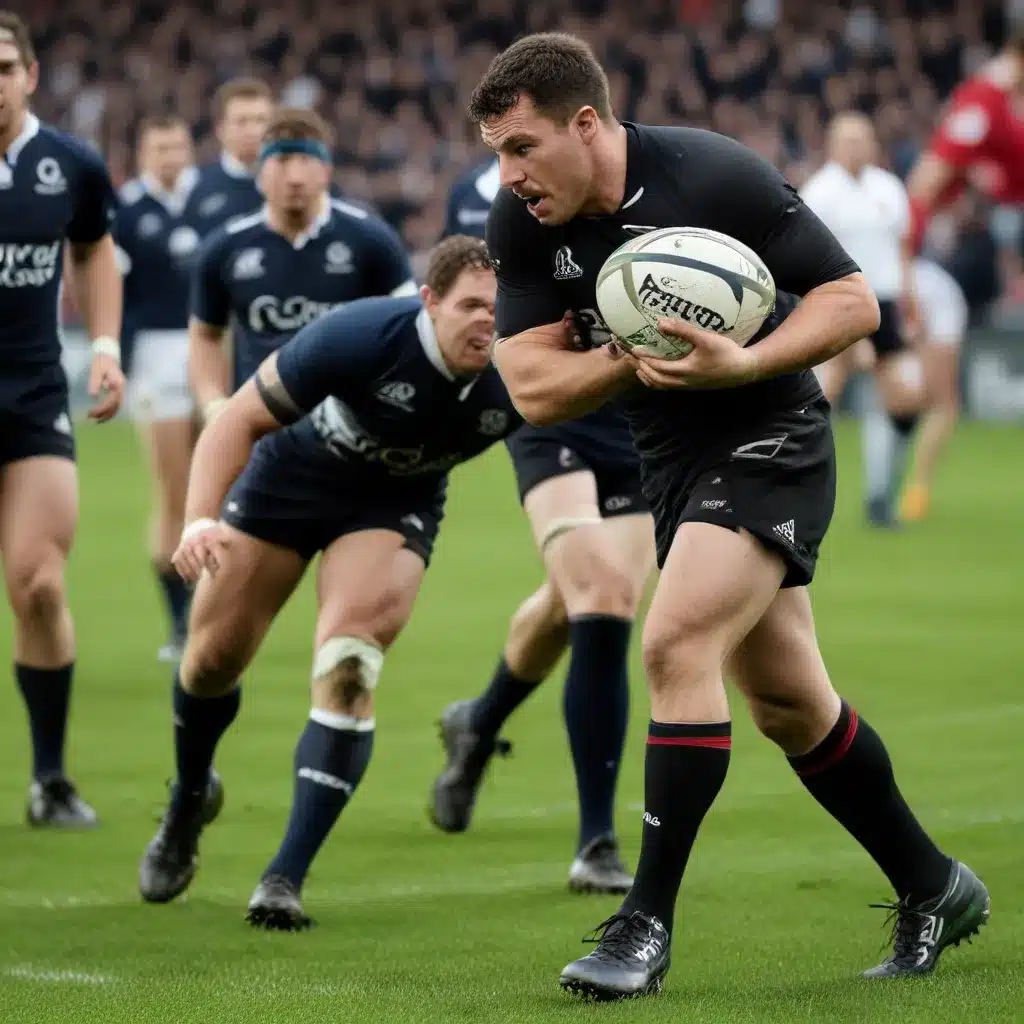
The Rugby Chip Kick: Mastering the High-Percentage Grubber
The Fundamentals of the Rugby Chip Kick
As a seasoned rugby professional, I’ve had the privilege of coaching players at all levels, from youth squads to the national team. One of the skills that I’ve found to be particularly impactful, yet often underutilized, is the rugby chip kick – and more specifically, the grubber variation.
The purpose of the chip kick is to penetrate the defensive line and create scoring opportunities. By lofting the ball just over the reach of the opposing players, you force them to react and attempt to field the kick, potentially leaving gaps in their coverage. When executed correctly, the chip kick can be a valuable weapon in any team’s attacking arsenal.
At its core, the mechanics of the chip kick involve striking the ball slightly beneath the equator, imparting a combination of elevation and forward momentum. This results in a low, skipping kick that bounces unpredictably, making it challenging for defenders to control. Mastering the nuances of foot placement, body positioning, and timing is essential to consistently delivering effective chip kicks.
Grubber Kicks: A High-Percentage Scoring Opportunity
The grubber kick is a specific type of chip kick that deserves special attention. Unlike the traditional chip, which aims to loft the ball over the defense, the grubber is a low, skidding kick that rolls along the ground. This presents a number of advantages:
Increased Accuracy: The grubber kick travels closer to the ground, making it easier to direct the ball precisely where you want it to land. This helps minimize errant kicks that go too high or too far.
Unpredictable Bounces: As the grubber rolls across the pitch, it can take unexpected bounces, causing confusion among the defending players. This can lead to turnovers or create space for the attacking team to pounce on the loose ball.
Scoring Opportunity: The grubber kick is an excellent way to force the opposition into a goal-line dropout or a 5-meter scrum. This gives your team a prime attacking position and a chance to score from the resulting play.
Ultimately, the grubber kick is a high-percentage play that can pay dividends when executed with skill and precision. It’s a versatile tool that can be utilized in a variety of game scenarios to disrupt the opposition and create scoring chances.
Mastering the Technique of the Chip Kick
Perfecting the chip kick, and the grubber in particular, requires dedicated practice and attention to detail. Let’s explore the key technical elements:
Foot Positioning and Body Alignment: When striking the ball, your plant foot should be slightly ahead of the ball, with your kicking foot approaching at a slight angle. Maintain an upright, balanced posture, keeping your core engaged and your weight evenly distributed.
Timing and Execution: The timing of the chip kick is critical. You want to strike the ball just as it reaches the peak of its bounce, allowing you to impart the desired elevation and forward momentum. A smooth, flowing kicking motion is essential, with a clean, decisive strike through the center of the ball.
Ball Contact and Spin: Focus on making contact with the equator of the ball, slightly beneath the center. This will help create the characteristic skidding, bouncing trajectory of the grubber kick. Avoid excessive spin, which can cause the ball to rise too high or veer off-course.
Consistent practice, both in training and game scenarios, will help you refine your technique and develop the muscle memory required to execute the chip kick with confidence and precision.
Tactical Considerations for Effective Chip Kicking
Identifying the right moments to unleash a chip kick is as important as the technical mastery. As a seasoned rugby professional, I’ve learned to read the defensive line and recognize opportunities to exploit any gaps or weaknesses.
Reading the Defensive Line: Observe the positioning and spacing of the opposing players. Are they pressing up aggressively, leaving space behind them? Or are they sitting deep, inviting you to test their coverage? Recognizing these cues will inform when and where to execute your chip kick.
Choosing the Right Moment: The optimal time to unleash a chip kick is typically when your team has gained good field position and momentum. Look for situations where the defense is slightly disorganized or caught off guard, or when you can catch them transitioning from attack to defense.
By combining technical proficiency with tactical awareness, you can elevate the chip kick to a formidable weapon in your team’s arsenal. Mastering this skill can change the momentum of a match and create scoring chances that might otherwise have gone begging.
Practicing and Perfecting the Chip Kick
Consistent, targeted practice is the key to elevating your chip kick to a high-percentage play. Incorporate a variety of drills and game scenarios to hone your technique and decision-making:
Drill Variations: Work on striking the ball from different angles and distances, experimenting with the height, speed, and trajectory of your kicks. Progress from stationary drills to moving targets, and eventually, full-field simulations.
Game Scenarios and Situational Training: Integrate chip kicks into your team’s training sessions, challenging players to recognize opportunities and execute the skill under pressure. Analyze game footage to identify missed chances or areas for improvement, and incorporate those insights into your practice.
Mastering the chip kick, especially the grubber variation, requires dedication and a willingness to experiment. But the rewards it can bring in terms of disrupting the opposition, creating scoring chances, and changing the momentum of a match make it a worthwhile investment of your time and effort.
The Impact of the Chip Kick in Rugby
The chip kick, when wielded with skill and tactical awareness, can be a game-changing weapon in rugby. Its ability to penetrate defenses, create scoring opportunities, and shift the momentum of a match is unparalleled.
I’ve seen firsthand how a well-timed, well-executed chip kick can turn the tide of a closely contested match. Suddenly, the opposition is on the back foot, scrambling to recover the ball and regroup, while your team pounces on the opportunity to gain valuable territory or even score.
The chip kick is not just a technical skill; it’s a testament to the player’s understanding of the game, their awareness of the defensive alignment, and their ability to make split-second decisions under pressure. It’s a tool that separates the good players from the great, and it’s a skill that every aspiring rugby professional should strive to master.
So, whether you’re a seasoned veteran or a rising star, I encourage you to embrace the chip kick, to experiment with the grubber variation, and to make it a cornerstone of your attacking repertoire. It’s a skill that can transform your game, elevate your team’s performance, and leave a lasting impact on the pitch.
Conclusion
The rugby chip kick, and the grubber kick in particular, is a high-percentage play that deserves the attention of every serious rugby player and coach. By mastering the technical nuances and the tactical timing, you can unlock a powerful weapon that can disrupt the opposition, create scoring opportunities, and shift the momentum of a match.
As a seasoned rugby professional, I’ve seen the transformative impact of the chip kick time and time again. It’s a skill that requires dedication, practice, and a deep understanding of the game, but the rewards it can bring are immeasurable.
So, whether you’re playing for your local club or representing your country, I challenge you to embrace the chip kick, to hone your grubber technique, and to unleash this game-changing skill on the pitch. The rugby world is yours to conquer, and the chip kick can be the key to unlocking your full potential.