
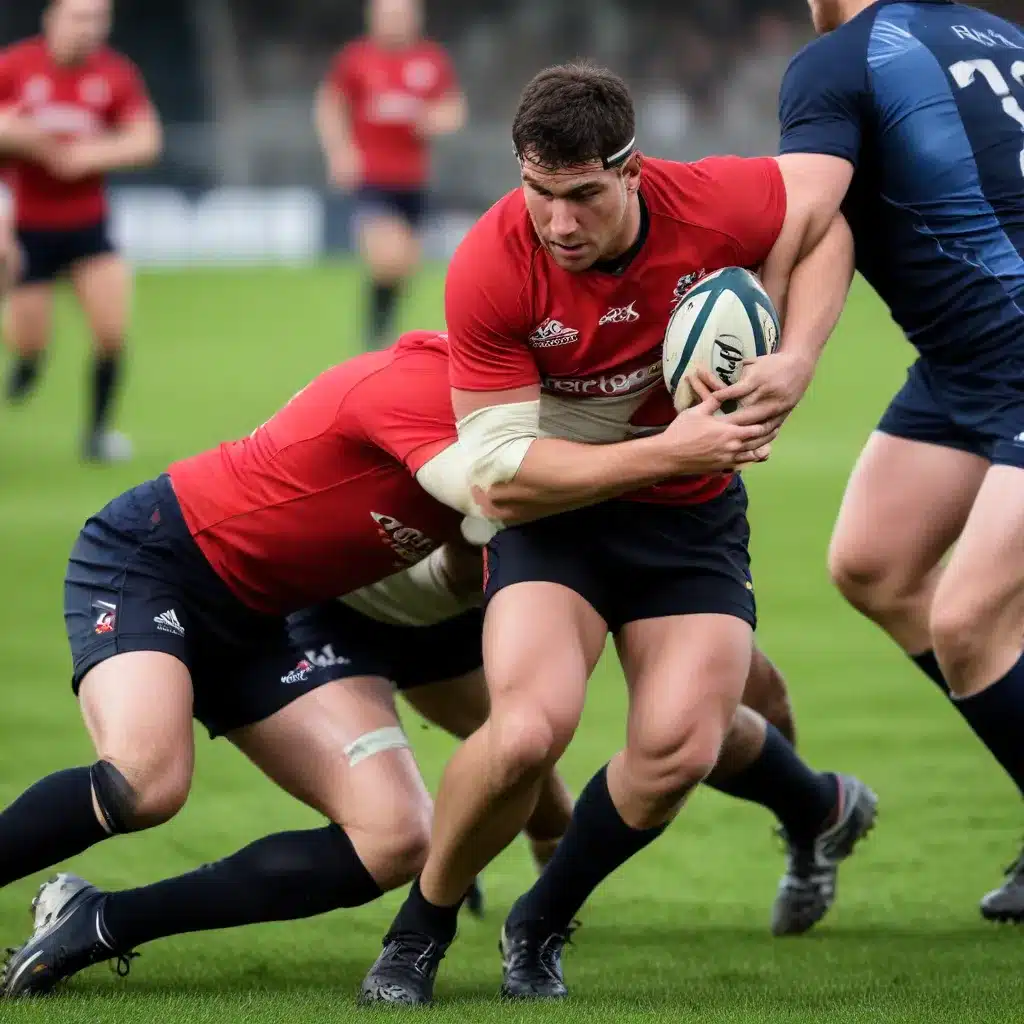
Tackle Mechanics
As a seasoned rugby professional, I know that mastering tackle technique is crucial for both player safety and performance on the pitch. At its core, the rugby tackle is a complex physical skill that requires precise body positioning, timing, and force application. Let’s dive into the key elements of effective tackle mechanics.
Body Positioning
Proper body positioning is the foundation of a successful tackle. Players must maintain a low, balanced stance with their center of gravity centered over their base of support. This allows for greater stability, power generation, and control during the contact. Keeping the head up and eyes focused on the target is also essential to maintain awareness and avoid dangerous head-on collisions.
Footwork and Balance
Agile footwork and balance are critical in the tackle. Players should take short, quick steps to close the distance to the ball carrier, keeping their feet shoulder-width apart and knees bent. This athletic stance enables players to quickly change direction, lean into the tackle, and maintain stability upon impact.
Point of Contact
The point of contact is where the tackle is initiated, and it can have a significant impact on the outcome. Ideally, the tackler should aim to make initial shoulder contact on the ball carrier’s near hip or mid-torso region. This target area allows for maximum force transfer while minimizing risk to the head and neck. Wrapping the arms around the ball carrier and driving through the contact is also key to securing the tackle.
Tackle Safety
Player safety should always be the top priority when it comes to the tackle. By emphasizing proper technique, we can mitigate the inherent risks associated with this contact situation.
Injury Risk Factors
Improper tackle technique is one of the primary risk factors for injury in rugby. Factors such as high-speed collisions, head-on impacts, and awkward body positions can all contribute to a heightened risk of injury, particularly to the head, neck, and shoulders. Understanding these risk factors and how to address them is crucial for player welfare.
Protective Equipment
While proper technique is the foundation, protective equipment can also play a role in enhancing tackle safety. Well-fitted, high-quality mouthguards, shoulder pads, and other protective gear can help absorb impact forces and reduce the risk of injuries. However, players must be cautioned against relying solely on equipment and instead focus on developing their technical skills.
Tackling Technique Modifications
In recent years, there has been a greater emphasis on modifying tackle techniques to prioritize player safety. This includes techniques such as the “dominant shoulder” tackle, where the tackler initiates contact with their near shoulder, keeping their head to the side of the ball carrier. Initiatives like World Rugby’s “Activate” program have also provided valuable guidance on safe and effective tackling methods.
Tackle Effectiveness
While safety is paramount, effective tackling is also essential for winning the physical contest and gaining an advantage on the pitch.
Tackle Outcome Metrics
Quantifying tackle effectiveness can be achieved through various metrics, such as tackle completion rate, dominant tackles, and turnovers won. These data-driven insights can help players and coaches identify areas for improvement and track progress over time.
Force Generation and Momentum
Generating sufficient force and momentum is key to securing dominant tackles. Proper body positioning, leg drive, and force transfer from the ground can all contribute to a powerful and effective tackle. Players must also be mindful of their timing and angle of approach to maximize the impact.
Tackle Timing and Angles
The timing and angle of the tackle can significantly influence its effectiveness. Anticipating the ball carrier’s movements, reading the play, and positioning oneself accordingly can make the difference between a dominant tackle and a missed opportunity. Mastering the ability to identify the optimal moment and angle to execute the tackle is a hallmark of elite rugby players.
Player Positioning and Alignment
Effective tackling is not just about the mechanics of the tackle itself; it’s also heavily dependent on the player’s positioning and body alignment before the contact.
Center of Gravity and Balance
Maintaining a low, balanced stance with the center of gravity centered over the base of support is crucial for both safety and effectiveness. This allows players to generate power, change direction quickly, and remain stable upon impact.
Body Alignment and Leverage
Proper body alignment, with the shoulders, hips, and feet all pointing towards the target, enables players to generate more force and leverage in the tackle. This alignment also helps the tackler maintain control and initiate the contact in the desired target area.
Footwork and Change of Direction
Quick, agile footwork allows players to close the distance to the ball carrier, adjust their angle of approach, and react to sudden changes in the play. Developing these footwork skills, such as lateral steps, pivots, and explosive acceleration, can significantly enhance a player’s tackling effectiveness.
Tackle Biomechanics
Understanding the underlying biomechanics of the tackle can provide valuable insights to optimize technique and reduce the risk of injury.
Joint Angles and Range of Motion
The positioning and range of motion of key joints, such as the hips, knees, and shoulders, directly impact a player’s ability to generate force, maintain balance, and absorb impact forces. Coaches and players should focus on improving mobility, flexibility, and joint stability to enhance tackle technique.
Muscle Activation Patterns
Specific muscle activation patterns are crucial for generating power, maintaining control, and protecting vulnerable areas during the tackle. Targeted strength training and neuromuscular control exercises can help players develop the necessary muscle recruitment strategies for effective and safe tackling.
Force Production and Transfer
The ability to generate and transfer force from the ground through the kinetic chain is a fundamental aspect of powerful tackling. Techniques such as leg drive, hip extension, and core stabilization all contribute to the efficient transfer of force during the contact.
Tackle Training Techniques
Effective tackle training is essential for developing both the technical skills and the confidence required to excel in this critical aspect of the game.
Drills and Skill Development
Incorporating a variety of tackle-specific drills, such as form tackling, contact scenarios, and reaction-based exercises, can help players refine their technique and build muscle memory. These drills should progressively increase in complexity and intensity to challenge players and prepare them for the demands of match play.
Technique Coaching and Feedback
Consistent, high-quality coaching and feedback are crucial for improving tackle technique. Coaches should provide detailed, individualized instruction, use video analysis to identify areas for improvement, and offer constructive feedback to help players make incremental technical adjustments.
Injury Prevention Strategies
Integrating injury prevention strategies, such as dynamic warmups, neuromuscular training, and targeted strengthening exercises, can help mitigate the risk of tackle-related injuries. These proactive measures not only protect players but also foster the confidence needed to engage in contact situations with a reduced fear of injury.
Improving Rugby Tackle Performance
Ultimately, the goal of enhancing tackle technique is to improve overall performance on the pitch. By combining a deep understanding of the mechanics, biomechanics, and training methodologies, players and coaches can elevate their game to new heights.
Evaluating Tackle Outcomes
Regularly assessing tackle outcomes, both in training and match situations, can provide valuable insights into a player’s or team’s strengths and weaknesses. By tracking metrics such as tackle completion rate, dominant tackles, and turnovers won, coaches can identify areas for improvement and develop targeted training plans.
Analyzing Tackle Metrics
Beyond just counting successful tackles, a more sophisticated analysis of tackle metrics can yield even greater insights. Factors like tackle speed, impact force, and tackle technique proficiency can be measured and used to refine training strategies and optimize in-game decision-making.
Optimizing Technique and Tactics
The pursuit of enhanced tackle technique should be accompanied by a holistic approach to player development and team tactics. By integrating technical refinements with sound tactical awareness, players can become more effective in their role and contribute to the overall success of the team.
At Aberdeenshire RFC, we are committed to providing our players with the knowledge, resources, and support they need to excel in the tackle. By emphasizing safe and effective technique, we aim to not only reduce the risk of injury but also empower our players to dominate the physical contest and gain a competitive edge on the pitch. Through a combination of expert coaching, progressive training, and data-driven analysis, we are confident in our ability to help players at all levels of the game reach new heights in their tackle performance.