
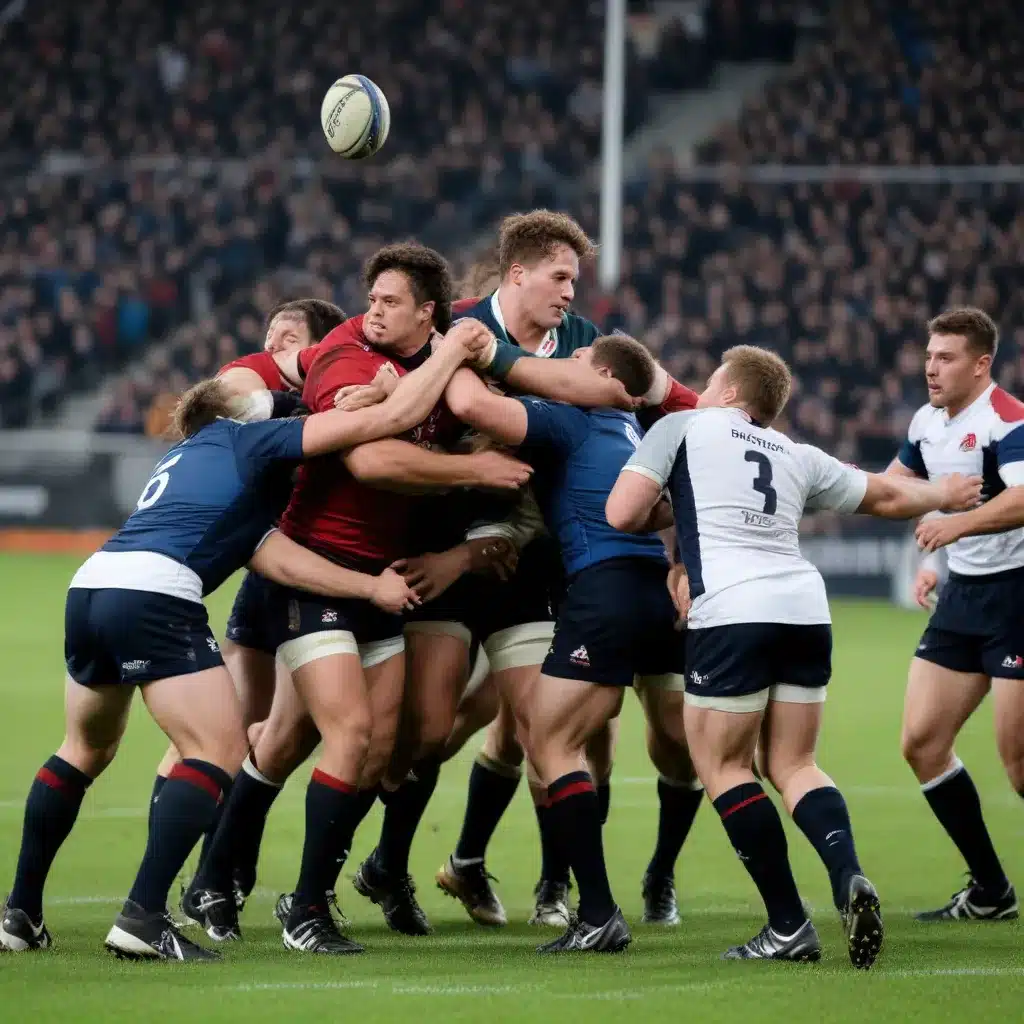
Rugby Line-Out Fundamentals
The line-out is a critical set-piece in rugby, where the ball is thrown in from the touchline after it has gone out of play. It offers a prime opportunity to win possession and gain territorial advantage. As a seasoned rugby professional, I’ve witnessed firsthand the importance of mastering line-out technique, timing, and communication to elevate your team’s performance.
The basic principles of a successful line-out are deceptively simple – the hooker must accurately throw the ball between the jumpers, who must time their leap to win the ball. However, the execution requires a level of coordination, athleticism, and strategic acumen that separates the elite teams from the rest.
Line-Out Technique
Jumping Technique
The jumping mechanics in a line-out are crucial. Jumpers must explode off the ground, extending their bodies to the fullest, while maintaining perfect balance and body alignment. Proper knee and hip extension, along with a powerful arm drive, are key to maximizing the height and hang-time of the jump.
Timing the jump is equally essential. Jumpers must anticipate the throw and coordinate their movement with the hooker’s release. A fraction of a second too early or late can mean the difference between winning and losing the ball. Jumpers should also be aware of their positioning relative to the opposition – standing slightly in front or behind the lifting pods can create an advantageous angle for the ball.
Lifting Technique
The lifters play a vital role in elevating the jumper to contest the ball. Their mechanics must be flawless, with a synchronized leg drive and upper body strength to hoist the jumper to the desired height. Maintaining balance and stability is crucial, as the lifters must resist being pushed back or knocked off-balance by the opposing pack.
Coordination between the lifters is essential. They must communicate and time their movements to create a stable and efficient platform for the jumper. Subtle cues, such as eye contact and weight shifts, can help the lifters anticipate each other’s actions and work in perfect harmony.
Throwing Technique
The hooker’s throwing technique is the foundation of a successful line-out. The ball must be released with pinpoint accuracy, trajectory, and spin to reach the intended jumper. Proper hand positioning, release point, and follow-through are all crucial factors.
Varying the throwing style can also be a valuable tactic. Short, quick throws can catch the opposition off-guard, while long, looping passes can create opportunities for the jumpers to outmaneuver their opponents. Mixing up the delivery keeps the opposition guessing and adds an extra layer of complexity to the line-out.
Line-Out Timing
Timing the Lift
Anticipating the opposition’s movements and timing the lift perfectly is a hallmark of an elite line-out. Jumpers and lifters must work in sync, reading the cues from the opposition and adjusting their timings accordingly.
Factors such as wind, rain, and pitch conditions can affect the timing and execution of the lift. Experienced teams have the flexibility to adapt and overcome these variables, ensuring their line-out remains a reliable source of possession.
Timing the Throw
Coordinating the throw with the lift is the final piece of the puzzle. The hooker must have an innate understanding of their jumpers’ capabilities and release the ball at the precise moment to maximize the chances of a successful catch.
Reacting to the opposition’s tactics is also crucial. A clever hooker will vary the timing and delivery of their throws to disrupt the opposition’s defensive line-out. This unpredictability can create scoring opportunities and frustrate even the most organized defensive units.
Line-Out Communication
Pre-Line-Out Communication
Effective communication starts long before the ball is thrown into the line-out. Identifying the opposition’s strengths and weaknesses, discussing strategies, and assigning specific roles and responsibilities are all crucial pre-line-out tasks.
Aberdeenshire RFC prides itself on a meticulous approach to line-out preparation. Our coaching staff extensively scouts the opposition, noting their preferred throwing patterns, jumping tendencies, and defensive strategies. We then devise a customized plan to exploit their vulnerabilities and maximize our chances of securing possession.
In-Line-Out Communication
During the line-out itself, clear and concise communication is essential. Jumpers and lifters must be linked in a seamless chain of verbal and non-verbal cues. Signals, such as hand gestures or eye contact, can help coordinate the lift, while shouts of “Now!” or “Lift!” can time the synchronized effort.
Adaptability is key. As the line-out unfolds, players must be able to adjust their communication in response to changing circumstances. A jumper spotting a mismatch or a lifter sensing an impending counter-drive must be able to quickly relay this information to their teammates, allowing for an immediate tactical adjustment.
Optimizing Line-Out Performance
Drills and Exercises
Developing individual technique and team coordination is an ongoing process at Aberdeenshire RFC. We place a strong emphasis on drill-based training, where players hone their jumping, lifting, and throwing skills, as well as their ability to work seamlessly as a unit.
One of our favorite drills involves having the jumpers and lifters practice their movements without the ball, focusing on timing and body positioning. This allows us to identify and correct any technical flaws, while also building the intuitive understanding that is so crucial to line-out success.
We also incorporate competitive line-out scenarios into our training sessions, challenging the players to make split-second decisions and adapt to evolving situations. This not only sharpens their skills but also fosters the communication and trust that are essential for a well-oiled line-out unit.
Scouting and Analysis
At Aberdeenshire RFC, we believe that thorough scouting and game-day analysis are the keys to unlocking our opponents’ line-out weaknesses. Our coaching staff meticulously studies footage of our rivals, looking for patterns in their throwing, jumping, and defensive strategies.
Armed with this intelligence, we can tailor our line-out approach to exploit their vulnerabilities. Perhaps we identify a taller jumper who struggles with low throws, or a hooker whose accuracy falters under pressure. By anticipating these tendencies, we can design specific plays and tactics to gain the upper hand.
Importantly, we don’t stop at the pre-game analysis. Our players are constantly monitoring the opposition’s line-out during the match, relaying any insights to the coaching staff. This allows us to make real-time adjustments and ensure our line-out remains a potent weapon throughout the 80 minutes.
Conclusion
The line-out is a complex and multifaceted aspect of rugby, where technique, timing, and communication converge to create a decisive advantage. As a seasoned rugby professional, I’ve witnessed the transformative impact that mastering these elements can have on a team’s performance.
By honing their jumping, lifting, and throwing skills, and developing seamless coordination and communication, the players of Aberdeenshire RFC have elevated their line-out into a formidable weapon. Through tireless drilling, meticulous scouting, and in-game adaptability, we have consistently outmaneuvered our opponents and secured vital possession at the most critical junctures.
The line-out may seem like a simple set-piece, but its true potential lies in the dedication, discipline, and synergy of the players who execute it. By embracing this holistic approach to line-out optimization, Aberdeenshire RFC has consistently maintained a decisive edge on the pitch, cementing our status as a force to be reckoned with in the ever-evolving landscape of rugby.