
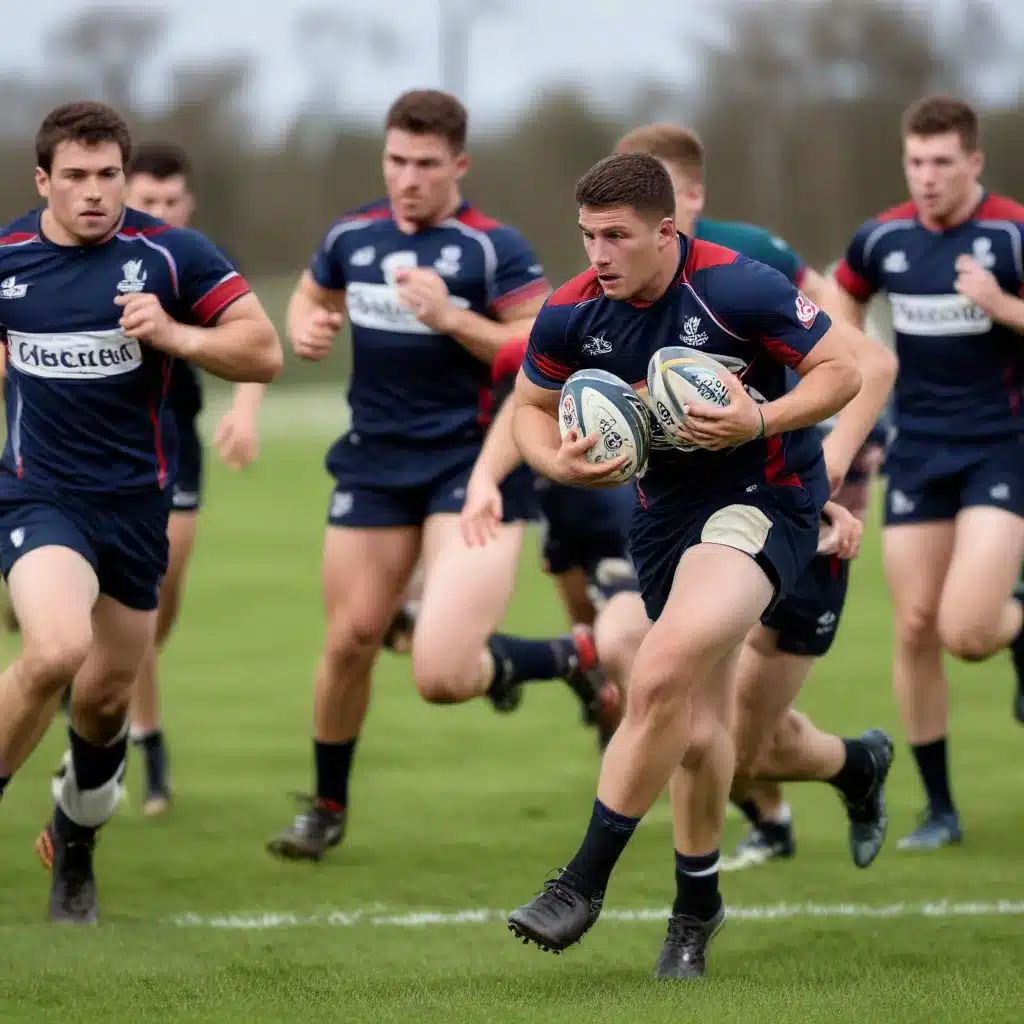
The Importance of Speed and Acceleration in Rugby
As a seasoned rugby professional, I know firsthand the critical role that speed and acceleration play in determining success on the pitch. Rugby is a demanding, high-intensity sport that requires explosive power, quick footwork, and the ability to change direction in an instant. Whether you’re an elusive back breaking through the defensive line or a powerful forward driving your way to the try line, these physical attributes can make all the difference.
Speed and acceleration are not only essential for attacking play, but also vital for effective defense. Defenders who can close down space quickly and keep pace with the opposition are often the difference between a try scored and a try saved. In the modern game, the margins are so fine that even a slight edge in acceleration or top-end speed can give a player the split-second advantage they need to gain the upper hand.
Fundamental Movement Patterns for Rugby Speed
Developing robust sprinting mechanics is the foundation for building rugby-specific speed and acceleration. Proper technique is key, as small adjustments to body position, foot strike, and momentum generation can have a dramatic impact on an athlete’s ability to rapidly cover ground.
Sprinting Mechanics
When coaching sprinting, I emphasize the importance of maintaining an upright, athletic posture with the chest up and shoulders back. The head should be in a neutral position, eyes focused straight ahead. As the athlete accelerates, the body should lean slightly forward from the ankles, allowing the center of mass to drive the movement.
Foot strike is crucial – the foot should land underneath the body’s center of mass, with the ankle, knee, and hip flexing to absorb impact and store elastic energy. A powerful, aggressive arm swing helps to counterbalance leg drive and maximize force transfer. The goal is for each stride to be long, powerful, and efficient, allowing the athlete to reach their top speed.
Agility and Change of Direction
In addition to straight-line sprinting, rugby players need to develop exceptional change-of-direction skills. This requires mastery of lateral movements, side-steps, and rapid deceleration/re-acceleration. We often incorporate agility drills using ladders, cones, and other markers to challenge players’ ability to quickly shift their momentum and change direction.
Key coaching cues for these drills include maintaining a low, athletic stance, keeping the head and eyes up to scan the field, and planting the outside foot firmly to generate lateral force. Developing a strong stretch-shortening cycle through plyometric exercises can also enhance an athlete’s ability to rapidly change direction.
Rugby-Specific Conditioning Drills
While general speed and agility work is important, it’s equally vital to incorporate training that replicates the specific movement patterns and physiological demands of rugby. This helps to develop the sport-specific qualities that will transfer directly to on-field performance.
Straight-Line Speed Drills
For building pure linear speed, I like to use short, maximal-effort sprints over distances of 10-30 meters. These could be simply straight-line dashes, or you could incorporate turns, evasions, or other sport-specific elements. The key is to ensure the athlete is sprinting at or near 100% effort for the entire rep, with ample recovery time between sets.
Multidirectional Speed Drills
To train the change-of-direction abilities so crucial in rugby, we’ll set up agility courses featuring zig-zags, shuffles, backpedals, and other multidirectional movements. These drills challenge the athlete’s ability to accelerate, decelerate, and re-accelerate while maintaining proper body control and technique.
One of my favorite drills is the “Get Up and Go”, where players start in a prone position on the ground, explosively rise up, and sprint 10 yards. This trains the critical skill of powerful acceleration from a low position, which is essential for bursting through contact.
Plyometric Exercises
Plyometric training is a cornerstone of our rugby speed and power development program. Exercises like box jumps, bounding, and hurdle hops help to improve the stretch-shortening cycle, reactive strength, and rate of force development – all key physical qualities for the modern game.
We’re particularly careful to progress these exercises slowly and ensure proper form, as improper plyometrics can increase injury risk. But when implemented correctly, they’re a highly effective way to enhance an athlete’s ability to produce and apply force rapidly.
Strength and Power Training for Speed
While speed and agility drills are the primary focus, strength and power development play a vital role in optimizing rugby-specific performance. Targeted resistance training helps to build the muscular foundation needed to express speed, acceleration, and power on the pitch.
Weightlifting Exercises
Classic compound lifts like the squat, deadlift, and clean are staples in our program. These exercises train the major muscle groups responsible for force production, while also improving movement mechanics and transfer of force through the kinetic chain.
We also incorporate more targeted exercises like split squats, step-ups, and single-leg deadlifts to address potential imbalances and build single-leg strength and power – an often-overlooked but crucial element for rugby players.
Plyometric Training
In addition to our field-based plyometric work, we integrate plyometric resistance training as well. Exercises like box jumps with added load, medicine ball throws, and weighted sled pushes help to develop the stretch-shortening cycle and explosive power characteristics so vital for rugby.
The key is to carefully monitor intensity and volume to avoid overtraining. We often employ a “conjugate” approach, alternating heavier, strength-focused sessions with lower-load, power-focused sessions to keep our athletes fresh and optimally prepared.
Periodization and Programming Considerations
Implementing an effective, periodized training plan is essential for maximizing rugby-specific speed and acceleration development over the course of a season. This requires carefully managing training loads, recovery, and the timing of key physical qualities.
In-Season Maintenance
During the competitive season, the primary focus shifts to maintenance of speed and power capabilities. We’ll typically use shorter, higher-intensity sessions focused on technical refinement and neuromuscular potentiation. This might include things like assisted sprints, resisted sled work, and low-volume plyometrics.
The emphasis is on preserving qualities like rate of force development and reactive strength without excessive fatigue buildup. Sufficient recovery time between these sessions is critical, as speed and power qualities are highly neurologically demanding.
Off-Season Preparation
In the pre-season and off-season, we ramp up the volume and intensity of our speed, strength, and power development work. This is the prime time to really focus on building the physical foundations that will carry over into the competitive phase.
We’ll often start with a “general preparation” phase focused on establishing a robust base of strength, followed by more specialized blocks emphasizing speed, acceleration, and power. Periodically, we’ll also integrate phases of metabolic conditioning to enhance the aerobic and anaerobic capacities required for the demands of rugby.
Monitoring and Evaluating Progress
Tracking the development of our players’ speed and acceleration capabilities is crucial for making informed adjustments to the training program. We utilize a variety of performance tests and monitoring tools to assess progress and identify areas for improvement.
Performance Testing
Our battery of tests includes straight-line sprint times over 10, 20, and 40 meters, as well as agility tests like the pro-agility shuttle and T-test. We also assess power output through vertical jump and broad jump testing. These objective metrics give us a clear picture of each athlete’s physical capabilities.
Adjusting Training Strategies
By analyzing the data from our testing, we can pinpoint the specific areas that need the most attention. For example, if an athlete is lacking in top-end speed, we may increase the volume of maximum-velocity sprinting in their program. Conversely, if change-of-direction is a weakness, we’d shift the focus to agility and multidirectional work.
Ongoing monitoring and evaluation allow us to constantly refine our training approaches, ensuring our athletes are optimally prepared for the rigors of the rugby season. It’s a never-ending process of assessment, adjustment, and continuous improvement.
Putting it All Together
Developing rugby-specific speed and acceleration is a multifaceted endeavor that requires a holistic, evidence-based approach. By focusing on proper technique, integrating sport-specific conditioning drills, and strategically programming strength and power training, we can help our players unlock their full athletic potential.
Ultimately, the goal is to create a training environment that allows our athletes to thrive. By equipping them with the physical tools and technical skills needed to dominate on the pitch, we can give them the best chance of success – whether they’re breaching the defensive line, chasing down a loose ball, or driving over the try line.
It’s a constant pursuit of excellence, but one that is deeply rewarding, both for the players and the coaching staff. Rugby is a game of inches, and the ability to make those crucial plays often comes down to the speed and acceleration of our athletes. By investing the time and effort into developing these critical physical qualities, we can give our team a decisive edge over the competition.