
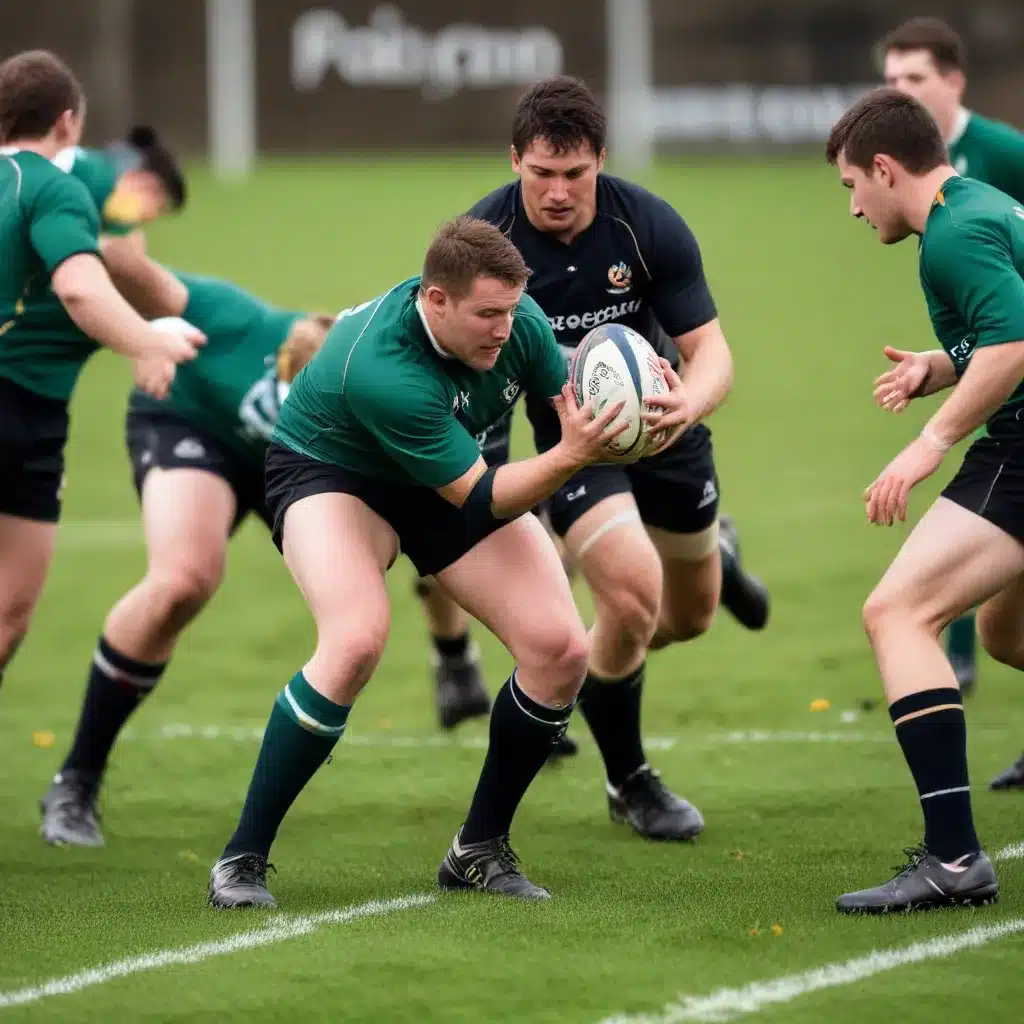
Rugby Passing Fundamentals
As a seasoned rugby professional, I know that passing is the lifeblood of the game. Whether you’re a forward or a back, being able to efficiently and effectively move the ball down the pitch is essential to success. At the heart of this is your passing technique – the foundation upon which all your handling skills are built.
Let’s start with the basics. Proper grip and hand positioning are crucial for delivering an accurate, controlled pass. Your fingers should be spread wide across the ball, with your thumbs placed on top. This provides maximum surface area and control as you release the pass. Align your body square to your target, with your weight balanced and your non-throwing shoulder pointed in the direction you want the ball to go.
Footwork and body positioning are also key. Take a short, choppy step forward as you pass, keeping your hips and shoulders squared up. Avoid over-reaching or lunging, as this can disrupt your balance and power transfer. The key is to maintain a strong, stable base that allows you to generate force through your core and into the ball.
Passing Technique Under Pressure
Now, the real challenge – passing under pressure. This is where the game often slows down, defenders close in, and the temptation to panic can set in. As a coach, I’ve seen many players revert to sloppy mechanics or hurried decision-making in these situations. But the best players are able to stay calm, composed, and execute their skills with precision.
The first step is to recognize pressure situations before they happen. Constantly scan the field, keep your head on a swivel, and anticipate when and where defenders will converge. This allows you to prepare your body and mind to deliver the pass.
When the pressure is on, you may need to make subtle adjustments to your passing technique. You may need to take an extra step to create space, or even consider a shorter, quicker pass to beat the onrushing defense. Maintaining that balanced, squared-up body position is critical, even as you have to react to the changing conditions around you.
Passing Drills and Exercises
To develop the ability to pass under pressure, you need to replicate those game-like scenarios in training. Start with stationary passing drills, gradually building in more movement, distance, and opposition. Have teammates apply passive pressure by jogging alongside you, then progress to active defenders closing in.
One of my favorite drills is the “9 Pass” exercise. Set up a grid with three lines of players, about 5 meters apart. The first player in the middle line starts with the ball and has to connect 9 consecutive passes before moving to the next line. Defenders from the outside lines can pressure the passer, forcing them to adapt their technique and decision-making.
Another valuable drill is the “Drifting Pass” – have players start in a line and pass the ball laterally down the line, drifting as they move. Introduce cones or defenders to force the passer to adjust their angle and timing. The key is to develop that split-second awareness and ability to execute under duress.
Developing Decision-Making for Passing
Of course, passing isn’t just about the physical technique – it’s also about the mental game. The best passers in rugby are masters of decision-making, able to recognize opportunities and react accordingly.
When under pressure, you need to quickly assess your options. Who is open? Where are the defenders? What’s the best angle and timing for the pass? Develop your field vision and peripheral awareness through regular game-based drills and small-sided scrimmages.
Anticipation is also crucial. Try to predict where the pressure will come from and have a mental checklist of potential passing solutions. This allows you to make quicker, more confident decisions when the moment of truth arrives.
Physical Conditioning for Passing
Passing accuracy and decision-making are heavily influenced by your physical preparation. Strength and power training can help you maintain control and stability under contact. Agility and change-of-direction drills will hone your ability to create space and find passing angles. And don’t forget about spatial awareness and reaction time – these are essential skills for reading the defense and delivering the ball on time.
Psychological Aspects of Passing Under Pressure
Of course, the mental side of the game is just as important as the physical. Confidence and composure are critical when the pressure is on. The best passers stay calm, focused, and in control, even as the intensity of the game rises around them.
Concentration and attention to detail are also key. You need to block out distractions and maintain laser-like focus on the task at hand. Emotional control is vital too – learn to manage the adrenaline rush and anxiety that can creep in when you’re in the heat of battle.
Coaching Strategies for Passing Skill Development
As a coach, my role is to guide players through this process of passing skill development. It’s not enough to just run drills – I need to provide targeted feedback, challenge players with progressions, and integrate passing into the broader team training.
I might start a session with technical work on grip, footwork, and body position. Then we’d move into more game-realistic scenarios, gradually increasing the pressure and complexity. Throughout, I’m watching closely, offering cues and corrections in the moment. My goal is to help players ingrain proper mechanics and decision-making until they become second nature.
Ultimately, the ability to pass effectively under pressure is what separates the good players from the great ones. It’s a skill that requires a holistic approach – blending technical, tactical, physical, and mental components. But with the right training and mindset, any player can develop into a true passing master.
If you’re looking to take your passing game to the next level, I encourage you to visit Aberdeenshire RFC – a club that prides itself on player development and a commitment to high-quality coaching. Together, we can work to elevate your handling skills and unlock your full potential on the pitch.