
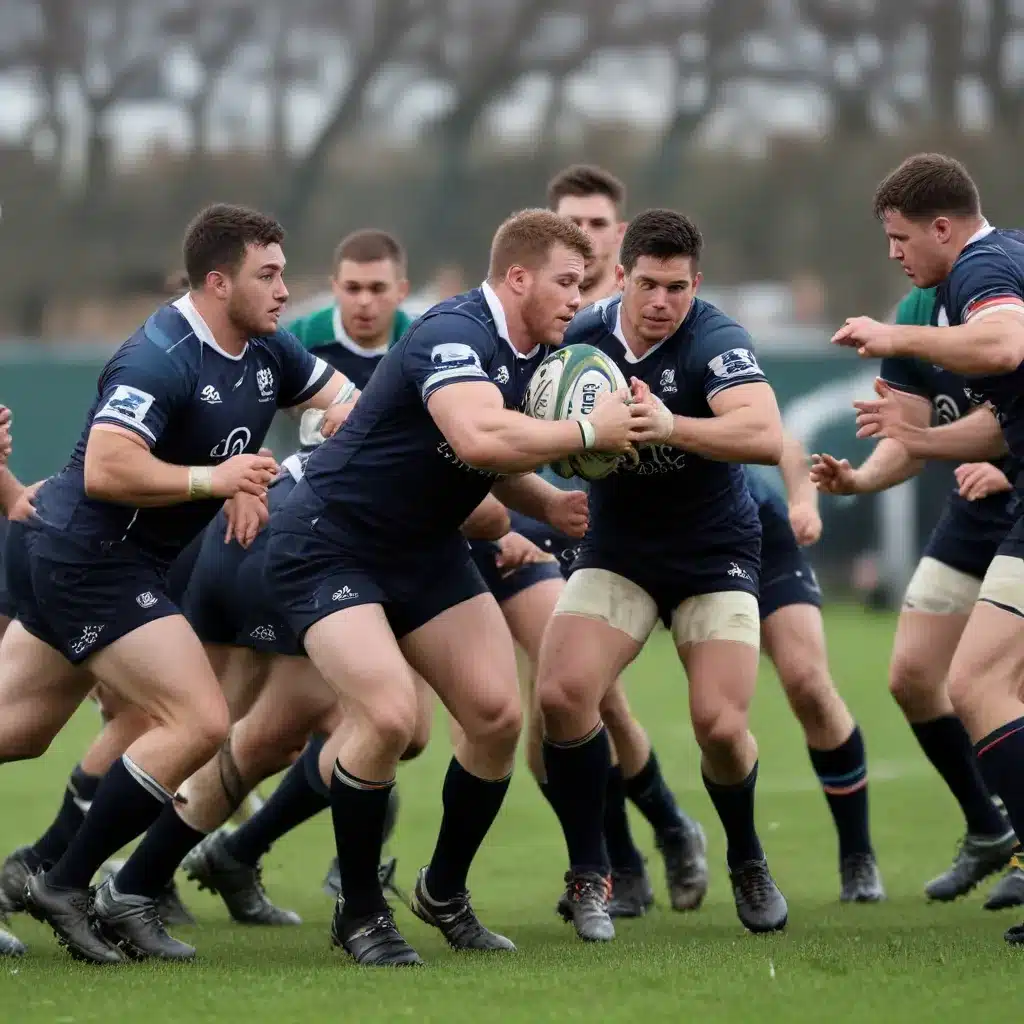
Ball Handling Fundamentals
As a seasoned rugby professional, I know that effective ball handling is the foundation for any potent attacking game plan. Developing a strong grip, controlled receiving, and confident carrying are essential skills that cannot be overlooked.
Let’s start with the basics of grip and control. Ensuring your players have a secure and adaptable hold on the ball is crucial. Encourage them to experiment with different hand positions – some may prefer a high, thumb-up grip for maximum control, while others find success with a lower, cradling grip. Emphasize the importance of using the whole hand, not just the fingers, to establish a sturdy connection with the ball.
Next, mastering the art of receiving passes is a must. Teach your players to watch the ball intently from the moment it leaves the passer’s hands. Stress the need for soft, cushioned hands that can seamlessly absorb the momentum of the pass. Encourage them to move their feet and body to get in line with the incoming trajectory, rather than reaching or lunging.
Finally, carrying the ball confidently is a hallmark of any skilled rugby player. Instill in your athletes the value of maintaining balanced, low body positions, with the ball tucked securely into the body. Advise them to scan the field ahead, keeping their heads up and eyes forward, ready to spot and exploit any emerging opportunities.
Offloading Techniques
Once the fundamentals of ball handling are ingrained, it’s time to focus on the art of the offload. Timing, vision, and passing mechanics are the keys to unlocking this critical attacking skill.
Timing the offload is all about anticipating the moment when the defense is stretched or unbalanced. Encourage your players to be patient and wait for the perfect opportunity, rather than forcing offloads into traffic. Cultivate their peripheral awareness, so they can sense the presence and positioning of supporting runners even as they focus on the immediate threat in front of them.
Passing mechanics are equally important. Emphasize the need for a smooth, fluid delivery that allows the ball to travel quickly and accurately to the intended target. Ensure your players are keeping their elbows high, releasing the ball off their fingertips, and following through with their passing motion. Varied passing drills, from short pop-passes to long, arcing deliveries, will help cement these technical skills.
Spatial awareness is the final piece of the offloading puzzle. Teach your players to constantly scan the field, identifying gaps and seams in the defense that can be exploited through precise offloads. Encourage them to play with their heads up, processing information rapidly and making split-second decisions about the best course of action.
Decision-Making in Offense
Offloading is not just a physical skill – it’s also a mental exercise that requires keen decision-making abilities. Helping your players read the defense, recognize passing opportunities, and manage risk will pay dividends on the pitch.
Reading the defense is crucial. Your players need to be adept at quickly analyzing the opposition’s alignment, anticipating their movement, and identifying potential seams or mismatches. Encourage them to look for clues like over-committed defenders, narrow defensive lines, or isolated opponents that can be targeted.
Once the opportunity presents itself, your players must be ready to pull the trigger. Emphasize the importance of recognizing high-percentage passing lanes and exploiting them with well-timed, well-placed offloads. Caution them against forcing offloads into crowded areas or against multiple defenders – sometimes the prudent play is to simply carry the ball or recycle possession.
Ultimately, decision-making in offense is about striking the right balance between risk and reward. Work with your players to develop a nuanced understanding of when to chance an offload and when to play it safe. Cultivate their ability to weigh the potential benefits against the costs, and make the call that gives the team the best chance of success.
Training Drills for Offload Improvement
Enhancing your players’ offload ability requires a multi-faceted approach to training. A combination of handling and passing exercises, scenario-based drills, and actionable feedback will help elevate their skills.
Start with the fundamentals – drills that focus on ball handling, catching, and passing mechanics. Incorporate activities like the “Two-Ball Bounce” drill, where players must quickly regather possession after a bounce pass. Or try the “Pass and Loop” drill, which challenges them to time their runs and deliveries to create overlaps.
Complementing these skill-based drills, scenario-based exercises will help your players develop their decision-making and spatial awareness. Set up “Overload Attack” drills, where players must identify and exploit numerical advantages. Or run “Continuous Defensive” drills that force them to make quick decisions under pressure.
Throughout the training process, provide your players with targeted, constructive feedback. Highlight examples of effective offloads, praise good decision-making, and offer specific technical cues to improve their execution. Encourage an open dialogue, soliciting their input and insights to further refine your coaching approach.
Tactical Considerations for Offloads
While individual skills and decision-making are paramount, tactically integrating offloads into your team’s game plan is equally crucial. Considerations around team strategies, formation, and positional support will all contribute to your success.
At the team level, align your players around a coherent offensive philosophy that values and enables offloading. Establish clear principles, such as looking to attack the space, keeping the ball alive, and flooding supporting runners. Empower your playmakers to orchestrate the attack, while ensuring the entire team understands and buys into the importance of the offload.
Formation and positioning also play a key role. Utilize width and depth to create passing lanes and draw defenders out of position. Encourage your backs to maintain depth and angle their runs to receive offloads, while your forwards must be prepared to provide close-quarter support. Experiment with different setups, from flat attacking lines to more staggered, multi-phase structures.
Ultimately, the success of your offloading game will hinge on the collective awareness and support of the entire team. Emphasize the importance of being on the ball carrier’s shoulder, ready to receive the pass and continue the attack. Foster an environment where everyone understands their role in creating and capitalizing on offloading opportunities.
Developing Offload Ability in Players
Enhancing your players’ offload ability is an ongoing process that requires a holistic, player-centric approach. From skill acquisition and progression to integrating offloads into game plans, there are numerous facets to consider.
Start by assessing each player’s current strengths and weaknesses. Identify areas for improvement, whether it’s handling, passing, or decision-making, and then craft individualized training plans to address those needs. Progression is key – build from the fundamentals, gradually increasing complexity and pressure to challenge your players’ abilities.
Equally important is reinforcing these skills within the context of team play. Provide opportunities for your players to apply their offloading prowess in live, game-like scenarios. Encourage them to take calculated risks, learn from mistakes, and continuously refine their decision-making. Celebrate successful offloads, while also addressing any concerning patterns or tendencies.
Ultimately, the goal is to ingrain offloading as a seamless, natural part of your team’s attacking arsenal. Weave it into your set plays and phase-play patterns, empowering your playmakers to orchestrate the attack. Cultivate an environment where offloading is encouraged, supported, and ultimately, rewarded.
At Aberdeenshire RFC, we are committed to developing well-rounded, adaptable rugby players who can thrive in the modern game. By honing their ball handling, decision-making, and offloading abilities, we equip our athletes with the tools they need to unlock their full potential and drive our team’s success. It’s an ongoing journey, but one that is immensely rewarding to witness.