
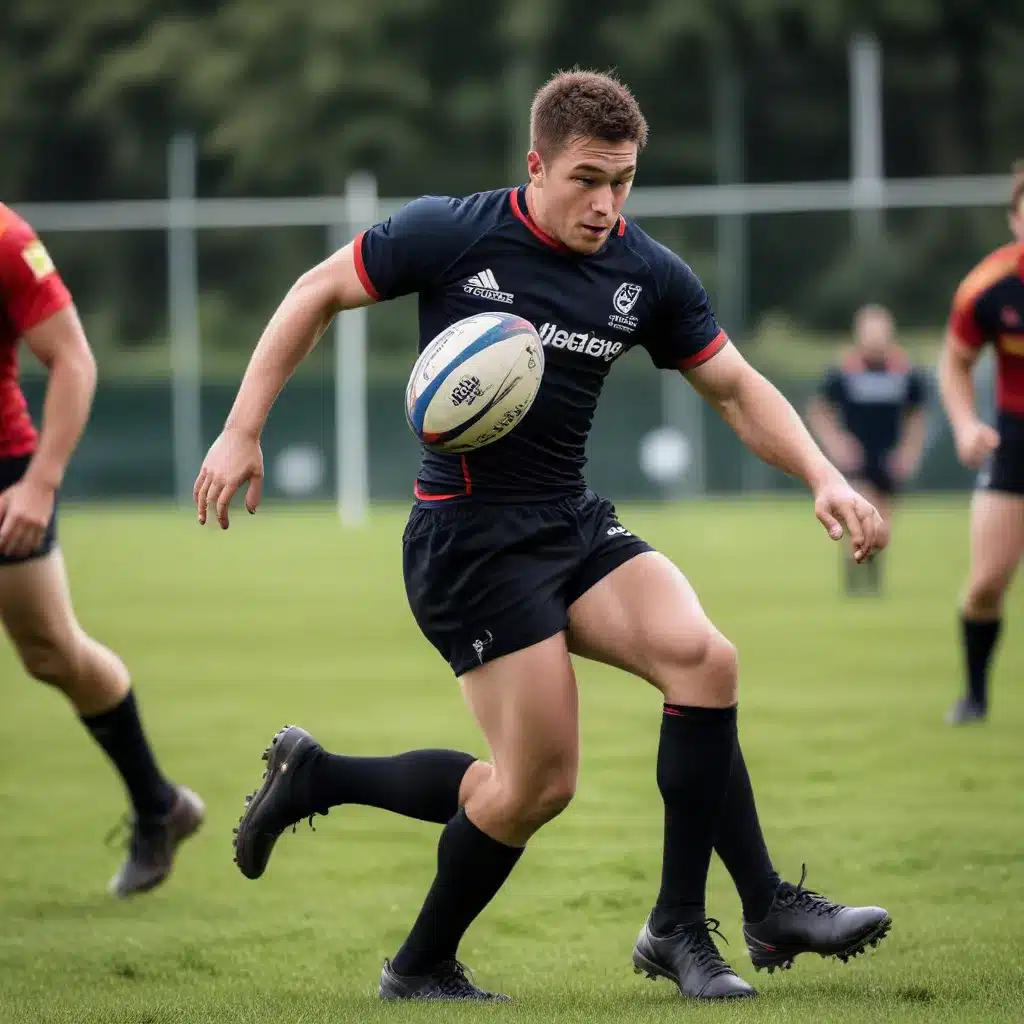
As a seasoned rugby professional with extensive experience in club operations, match analysis, training methodologies, and global rugby insights, I’m excited to share my expertise on improving rugby kicking technique. Kicking is a fundamental skill in the game of rugby, and mastering it can make a significant difference in your team’s performance, both in open play and in goal-kicking situations.
Rugby Kicking Fundamentals
Kicking in rugby is a complex skill that requires a combination of technical proficiency, physical abilities, and mental focus. At its core, kicking involves the mechanics of foot-to-ball contact, the biomechanics of the body’s movements, and the coordination of various muscle groups.
Kicking Mechanics
The mechanics of kicking in rugby can be broken down into several key components. First, the approach to the ball is crucial – a smooth, balanced run-up helps to ensure consistent contact and direction. The plant foot should be positioned slightly ahead of the ball, with the kicking foot drawn back, ready to strike. The hips and shoulders should be aligned with the target, and the eyes should be focused on the optimal contact point on the ball.
Biomechanics of Kicking
From a biomechanical perspective, kicking in rugby involves the coordinated movement of the legs, hips, trunk, and arms. The kicking leg should generate power through a combination of leg strength, hip rotation, and explosive movements. The non-kicking (or “support”) leg plays a vital role in maintaining balance and stability during the kick.
Kicking Accuracy
Accuracy is a crucial aspect of kicking in rugby, whether it’s goal-kicking, tactical kicking, or set-piece kicking. Achieving consistent accuracy requires attention to several key elements:
Foot Positioning
The position of the kicking foot at the point of contact is critical for accuracy. The foot should make contact with the ball near the center, with the ankle locked and the toes pointed slightly inwards. This helps to ensure a clean, consistent strike and minimizes any lateral deviation.
Ball Contact Point
The point of contact on the ball is also essential for accuracy. Aim to strike the ball on the “sweet spot,” which is typically the center of the ball’s surface. Avoid hitting the ball too high or low, as this can cause the trajectory to veer off-target.
Follow-Through
The follow-through of the kicking motion is often overlooked, but it plays a vital role in maintaining accuracy. After making contact with the ball, the kicking leg should continue its natural swing, with the foot following through in the direction of the target. This helps to ensure a smooth, balanced, and consistent kicking motion.
Kicking Power
Generating power in your rugby kicks is essential, especially for long-distance kicks, goal-kicking, and tactical kicking. Building kicking power involves a combination of physical conditioning and technical proficiency:
Leg Strength
Developing leg strength, particularly in the quadriceps, hamstrings, and calves, is crucial for generating power in your kicks. Incorporating targeted strength training exercises, such as squats, deadlifts, and plyometric drills, can significantly improve your kicking power.
Hip Rotation
The rotation of the hips during the kicking motion is a key driver of power. Ensure that your hips are properly aligned and that you’re able to generate a smooth, explosive rotation from the ground up, using your core muscles to transfer energy to the kicking leg.
Explosive Movements
Incorporating explosive movements, such as jump squats, box jumps, and power cleans, into your training routine can help to enhance the power and explosiveness of your kicking motion.
Kicking Consistency
Consistency is the hallmark of a top-level rugby kicker. Achieving consistent kicking performance requires a combination of deliberate practice, mental focus, and an understanding of environmental factors:
Repetition and Practice
Consistent kicking performance is built through repetition and deliberate practice. Set aside dedicated time to work on your kicking technique, focusing on executing each kick with precision and attention to detail. Develop a routine that you can rely on during matches.
Mental Focus
Maintaining mental focus and concentration is essential for consistent kicking performance. Visualize the perfect kick, and use pre-kick routines and mental cues to help you stay present and focused in the moment.
Environmental Factors
Factors such as wind, rain, temperature, and field conditions can all have a significant impact on kicking performance. Develop an understanding of how these environmental factors affect the ball’s trajectory and adjust your kicking technique accordingly.
Rugby Kicking Drills and Exercises
Improving your rugby kicking technique requires a comprehensive training approach that addresses accuracy, power, and consistency. Here are some effective drills and exercises to incorporate into your training regimen:
Stationary Kicking Drills
Start with basic stationary kicking drills, focusing on technique and form. Set up targets at varying distances and practice kicking with precision, emphasizing the key elements of foot positioning, ball contact, and follow-through.
Dynamic Kicking Drills
Progress to dynamic kicking drills that simulate match-like scenarios. Incorporate movement, such as running, changing direction, or receiving a pass, before executing the kick. This helps to develop your kicking technique under pressure and in a more realistic setting.
Strength and Conditioning Exercises
Complement your kicking-specific drills with targeted strength and conditioning exercises to build the physical attributes needed for powerful and consistent kicking. Focus on exercises that develop leg strength, hip mobility, and explosive power.
Analyzing and Improving Kicking Technique
Regularly analyzing and refining your kicking technique is essential for continuous improvement. Utilize the following approaches to identify areas for development and make adjustments:
Video Analysis
Record your kicking sessions and review the footage, looking for areas where your technique can be refined. Identify any inconsistencies or technical flaws, and work on addressing them through focused practice.
Coaches’ Feedback
Seek out the guidance and feedback of experienced coaches who can provide valuable insights and recommendations for improving your kicking technique. Be open to their suggestions and incorporate them into your training.
Reflection and Self-Evaluation
Take time to reflect on your kicking performance, both in training and during matches. Assess what’s working well, what needs improvement, and develop a plan to address any areas of weakness.
Remember, the journey to mastering rugby kicking technique is a continuous one. By focusing on the fundamentals, deliberate practice, and a willingness to adapt and improve, you can elevate your kicking performance to new heights and make a significant contribution to your team’s success.
For more information on rugby training and resources, be sure to visit the Aberdeenshire RFC website at https://www.aberdeenshirerfc.org.uk/. Their dedicated coaches and staff are always eager to share their expertise and support players in their pursuit of rugby excellence.